
Duval County Court Records After a Jail Arrest
After a Duval County arrest, the first public trace is usually the sheriff's booking record. The court record is a separate thing. Once someone is booked, the State Attorney reviews the police reports and decides whether to file charges, and it is that filing decision that opens the court case. From that point the clerk maintains the docket, the filed charges, and the disposition. A booking charge and a filed court charge are not always the same, which is why the court record is the formal source for what a person is actually accused of.
Keep the two sides clear. The arrest and booking detail, including custody status and the booking photo, live with the sheriff. You can follow the custody side on the jail inmate records page, and the booking photo question on the jail mugshots page. The court record itself, the charges the prosecutor filed and how they moved, is searched through the clerk's case system described next.
First Appearance and the Court Record Pathway
An arrest in Duval County moves through a set order before it becomes a full court record. The sheriff staffs First Appearance court every day of the year, where a judge reviews the arrest, sets or denies bond, and advises the person of the charges. The State Attorney for the Fourth Judicial Circuit then reviews the police reports and decides what to file. Only when a charging document is filed does the clerk open the court case and start the docket. That docket is the lasting court record, and it tracks hearings, motions, plea, sentence, and disposition over the life of the case.
This order is why a fresh arrest can show on the jail roster before a full court record exists. The booking posts within hours, but the prosecutor's filing decision can take longer, and the charges that are filed may differ from the charges listed at booking. Reading both the jail profile and the CORE docket gives the clearest picture early on, since each one holds a different piece of the same case. The custody side answers where a person is, while the court side answers what they are formally accused of.
How to Find Duval County Court Records After an Arrest
The Duval County Clerk runs the court case portal known as CORE. The clerk explains that since 2014 the Florida Supreme Court has allowed public online viewing of non-confidential court records, with confidential material protected. General public users can view non-confidential records in non-confidential case types, but cannot pull documents that have not been reviewed and published for viewing. A missing document is often a matter of access level or review status rather than a failed search.
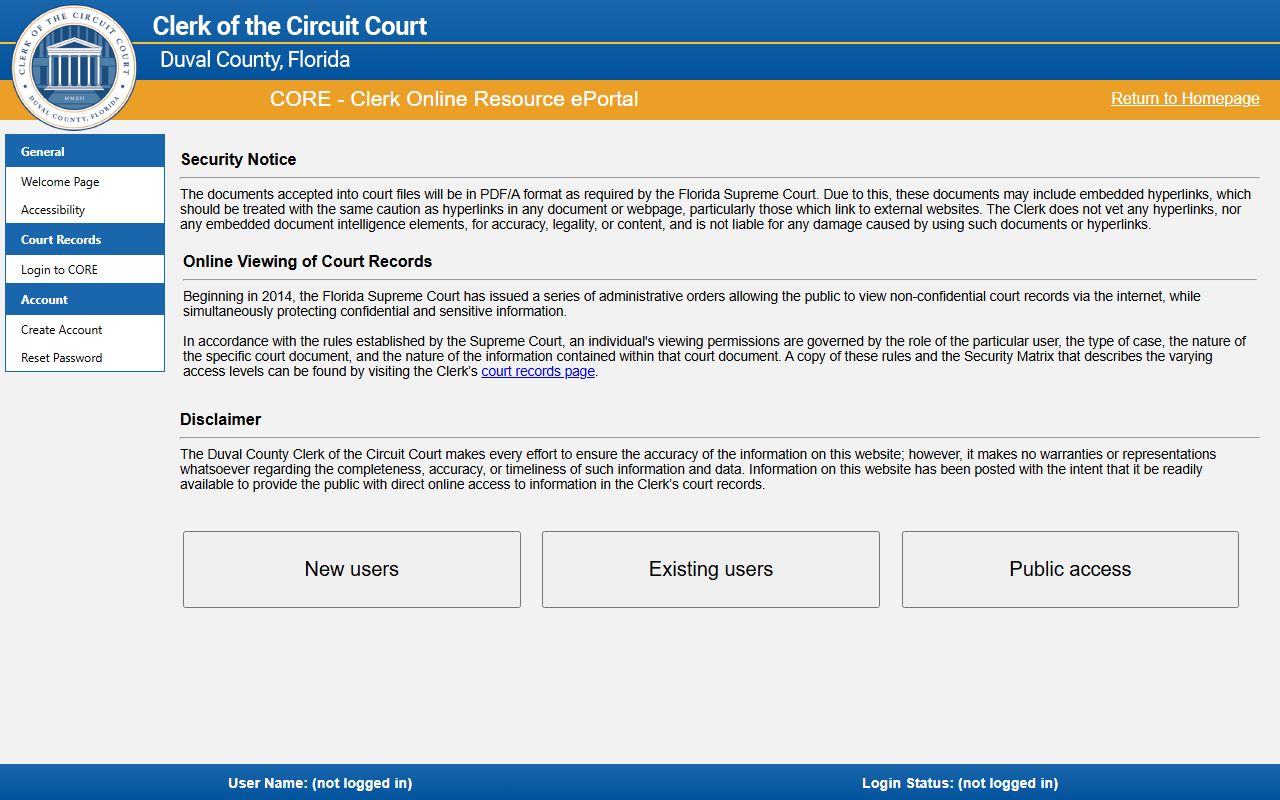
The CORE portal above is where charges and charge status appear once a case is filed. The steps below outline a basic search.
- Open the Duval Clerk CORE portal at core.duvalclerk.com.
- Search by the defendant's name or by the case number if you have one.
- Open the case and read the list of filed charges.
- Check each charge's statute, level, and current status on the docket.
For a broader history beyond a single Duval case, a statewide criminal-history product from the state is a different tool with its own fees and scope. The clerk's misdemeanor record search, for example, lists a search fee of 1.50 dollars per year searched.
The clerk ties online access to Florida Supreme Court order AOSC24-65 and a security matrix. That matrix decides what a viewer can see based on the user's role, the case type, the document type, and the nature of the information. A general public user can read non-confidential records in non-confidential case types, but cannot pull documents that have not been reviewed and published for public viewing. Older or more sensitive files may need a separate records request, and the clerk publishes a complex public and court records request process for those cases.
How Charges Get Filed After an Arrest: Complaint, Information, and Indictment
The court record starts with a charging document. After the arrest and booking, the prosecutor for the Fourth Judicial Circuit decides what to file and in what form. The form depends on the seriousness of the case. The three main types are below, with who files each and what it is typically used for.
| Complaint | Information | Indictment | |
|---|---|---|---|
| Filed By | Officer / Prosecutor | Prosecutor (State Attorney) | Grand Jury |
| Common For | Misdemeanors | Many felonies | Serious felonies |
| Starts | The case | The case | The case |
The State Attorney's Office for the Fourth Judicial Circuit serves Clay, Duval, and Nassau counties. That circuit-level structure is why the prosecutor is a State Attorney rather than a county district attorney.
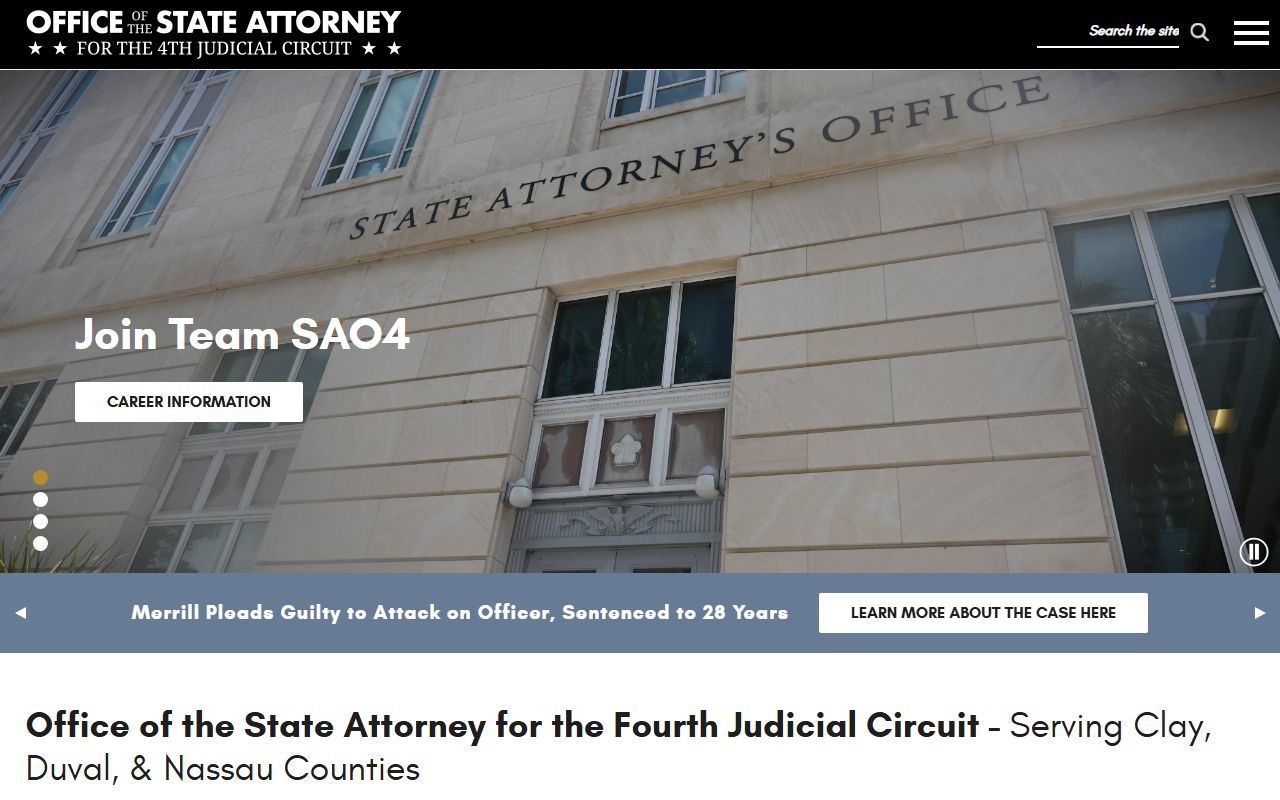
This is the office that reviews the arrest and decides which charges become the court record.
Charge Status on the Court Record After an Arrest
Charges are not fixed once a case opens. They can be amended, reduced, added, dropped, or dismissed as the case moves through court. The booking charges on the jail roster may differ from what the prosecutor finally files, and only the court docket shows the current state. The table defines the status terms you will see most often.
| Status | What It Means |
|---|---|
| Pending | The charge is filed and the case is open, with no final outcome yet. |
| Amended / Reduced | The charge was changed, often to a lesser offense, after review. |
| Dismissed | The charge was dropped and is no longer being pursued. |
| Nolle Prosequi | The prosecutor chose not to proceed on the charge. |
Note: Court outcomes like dismissed, amended, or adjudication withheld belong to the court docket, not the jail roster, so check CORE for the current status.
Bond and Release After an Arrest
Bond is usually set early, at First Appearance court, which the sheriff staffs every day of the year. A cash bond is paid in full at the jail's public reception area, in cash, a certified or cashier's check on a local bank subject to verification, or a United States Postal money order payable to the Office of the Sheriff. A bonding agency can post a surety bond instead, though sheriff staff may not recommend an agency. A civil purge amount set by a judge is paid to the courthouse Domestic Relations Department during business hours or at the jail after hours.
| Bond Type | How It Works |
|---|---|
| Cash Bond | Full amount paid at the jail reception in approved forms; no personal checks or cards listed. |
| Surety Bond | A licensed bail-bond agency posts the bond; the sheriff cannot suggest one. |
| Purge (Civil) | A judge-set amount in a civil or writ matter, paid to clear the hold. |
| No-Bond Hold | A court order, detainer, or another-agency hold can keep a person in custody even after a bond is paid. |
Warrants That Lead to an Arrest
Many bookings begin with a warrant. An arrest warrant authorizes an arrest for an alleged offense, while a bench warrant is often issued when a person misses a court date or violates a court order. A bench warrant can show up as a docket entry in the court case even before the person is in custody. The sheriff links a Wanted resource for crime tips, but it is not a complete warrant-clearance list, so the practical route is the court case search plus the sheriff's non-emergency and public-records lines. Once a warrant is served and the person is booked, they should appear in the jail search if the record is public.
Charges vs. Convictions
Being arrested and charged is not the same as being convicted. A charge is an accusation that opens the case. A conviction comes only at the end, through a plea or a verdict.
| Charge | Conviction | |
|---|---|---|
| Stage | Accusation | Verdict or plea |
| Burden of Proof | Probable cause | Beyond a reasonable doubt |
| Public Record | Yes | Yes |
Sealed vs. Expunged Court Records After an Arrest
Florida lets some people clear a record after a dismissal or an eligible disposition. Sealing hides the record from public view, while expunction goes further and treats it as if it never existed. The state expunction process runs through Florida Statute 943.0585 and usually involves the court, the clerk, and the state law-enforcement department. The table compares the two routes.
| Sealed | Expunged | |
|---|---|---|
| Visibility | Hidden from public | Destroyed or treated as never existed |
| Law Enforcement | Limited access | Very limited access |
| Basis | Court order under state law | Florida Statute 943.0585 |
Background Check Considerations
A casual name search of court records is not the same as a regulated background check. A formal screening for jobs, housing, or credit must follow the federal Fair Credit Reporting Act and use a licensed consumer reporting agency. The free public records covered here do not meet that standard and are not built for those uses.
Important: This site is not a consumer reporting agency under the FCRA, and nothing here may be used for employment, housing, credit, or insurance screening.
Restricted Court Records After an Arrest in Duval County
Not every court record is open to the public. Florida Rule 2.420 and the Supreme Court access matrix protect confidential material, and some categories are closed by their nature. Juvenile cases, sealed or expunged matters, and records tied to an active investigation may not appear in a public CORE search. A withheld document does not always mean the case is hidden. It can mean the file has confidential content, has not been reviewed for release, or sits at an access level the general public cannot reach.